
Processing Our
Wild
Clay


By digging up and processing locally sourced clay, we are preserving an age-old craft that connects our tiles to the place were they were made and its geological history.
A little over 12,000 years ago, during the ice age, the glaciers had retreated northeast of our location. The glacier-fed water of Lake Ontario was much higher than it is today and over many centuries ground up rock (clay) from glacial runoff settled to the lake bottom. This clay is a blend of igneous rock from the Canadian Shield to our north and local limestone.
This earthenware clay that we dig up today was used in the 19th Century to make the red bricks for Victorian-era buildings.

A. Harvesting the raw clay
from our yard. Layers of clay deposited over centuries can be seen. There are large deposits of lacustrine clay ( lake bottom clay) in our area.

B. Slaking the Clay
in water buckets. After a vigorous stirring it sits for a couple of days. Soluble salts are skimmed off the top of the water.
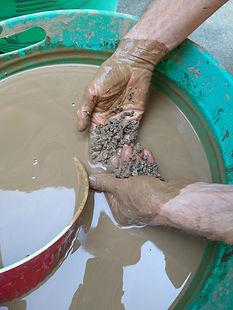
C. Preparing the clay
before screening. We break up the larger clumps and remove twigs and other organic debris. Finer sand is left in the clay.

D. Screening the Clay
through two layers of mesh. The clay is poured through the screens, removing gravel and remaining organics.

E. The pillowcase method
is used to remove excess water from the clay. Filled with the wet clay, the water drips out.

F. Drying the Clay
for a couple of days. The pillowcases are hung in the sun and wind.

G. Finishing the Drying
on plaster slabs to remove all the remaining moisture from the clay.
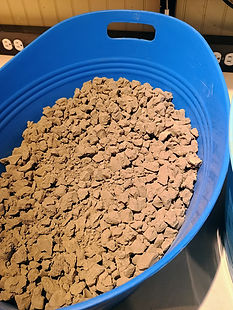
H. Storing Clean Clay
once it has dried fully. This clay will be become 60% to 75% of our tile clay body.
Our clay recipes took three years of research and test firings to develop. This video shows the entire process we use to refine and blend our tile clay.
A video showing how we make our clay
