
What is Clay?
-
Clay is rock that has been broken down over thousands of years by water, ice and wind into microscopic sized particles.
-
These tiny particles attract water molecules with an electrical charge and hold onto them.
-
The water becomes a glue and a lubricant that gives the billions of clay particles the ability to stick together and to move past each other.
-
This is why clay is plastic (moldable) when wet.
-
This unique characteristic has made it a valuable resource throughout human history for making pottery, tiles and bricks.
Two Types of Clay
The two types are primary clay and secondary clay.
Primary clay is found close to its original rock. It weathered in place and is pure in composition with a large particle size. Kaolin, from which stoneware and porcelain pottery is made, is an example of this type of clay.
Secondary or sedimentary clay has been transported, often hundreds of miles, from its original rock by water or glaciers or wind. During the move, the clay is ground to a finer and finer particle size. It is also mixed with many other minerals.
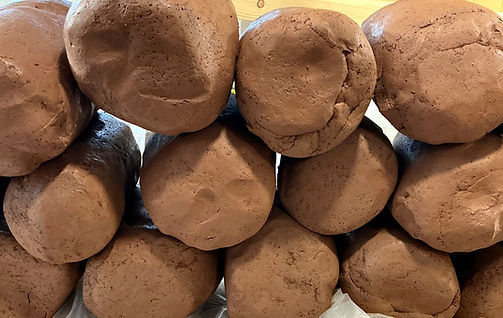
This is the more common of the two clays. Earthenware and terra cotta are examples of this kind of clay. It's the type of clay we dig up.